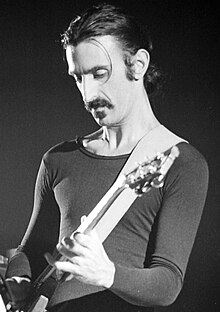
Frank Vincent Zappa[1] (December 21, 1940 – December 4, 1993) was an American composer, electric guitarist, record producer and film director. In a career spanning more than 30 years, Zappa wrote rock, jazz, electronic, orchestral, and musique concrète works. He also directed feature-length films and music videos, and designed album covers. Zappa produced almost all of the more than 60 albums he released with the band Mothers of Invention and as a solo artist.
In his teens, he acquired a taste for percussion-based avant-garde composers like Edgard Varèse and 1950s rhythm and blues music. He began writing classical music in high school, while at the same time playing drums in rhythm and blues bands—he later switched to electric guitar. He was a self-taught composer and performer and his diverse musical influences led him to create music that was often impossible to categorize. His 1966 debut album with the Mothers of Invention, Freak Out!, combined songs in conventional rock and roll format with collective improvisations and studio-generated sound collages. His later albums shared this eclectic and experimental approach, irrespective of whether the fundamental format was one of rock, jazz or classical. He wrote the lyrics to all his songs, which—often humorously—reflected his iconoclastic view of established political processes, structures and movements. He was a strident critic of mainstream education and organized religion, and a forthright and passionate advocate for freedom of speech and the abolition of censorship.
Zappa was a highly productive and prolific artist and he gained widespread critical acclaim. Many of his albums are considered essential in rock history, and he is regarded as one of the most original guitarists and composers of his time; he remains a major influence on musicians and composers. He had some commercial success, particularly in Europe, and for most of his career was able to work as an independent artist. Zappa was posthumously inducted into the Rock and Roll Hall of Fame in 1995 and received the Grammy Lifetime Achievement Award in 1997.
Zappa was married to Kathryn J. "Kay" Sherman from 1960 to 1964, and in 1967 he married Adelaide Gail Sloatman, with whom he remained until his death from prostate cancer in 1993. They had four children: Moon Unit, Dweezil, Ahmet Emuukha Rodan and Diva Thin Muffin Pigeen. Gail Zappa manages the businesses of her late husband under the name the Zappa Family Trust.