Piano Sheets > Miles Davis Sheet Music > Blue In Green (ver. 1) Piano Sheet

Blue In Green (ver. 1) by Miles Davis - Piano Sheets and Free Sheet Music

  
About the Song
   Other avaliable versions of this music sheet: Version 1  Version 2  
"Blue in Green" is the third track on Miles Davis' 1959 album, Kind of Blue. One of two ballads on the LP (the other being "Flamenco Sketches"), "Blue in Green"'s melody is very modal, incorporating the presence of the dorian, mixolydian, and lydian modes. The first measure is a G minor chord with an added natural 13 (Gm13), which contains an F natural but the modality of the piece is already evident as the opening note of the melody is an E natural, which is the leading tone of the F major scale. The natural 13 of the chord is E natural. It has long been speculated that pianist Bill Evans wrote "Blue in Green"[1], even though the LP and most jazz fakebooks credit Davis only with its composition. In his autobiography, Davis maintains that he alone composed the songs on Kind of Blue. The version on Evans' trio album Portrait in Jazz, recorded in 1959, credits the tune to 'Davis-Evans'. Earl.    Download this sheet!
About the Artist
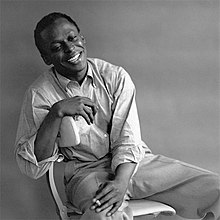
Miles Dewey Davis III (May 26, 1926 – September 28, 1991) was an American jazz trumpeter, bandleader, and composer. Widely considered one of the most influential musicians of the 20th century, Davis was at the forefront of almost every major development in jazz from World War II to the 1990s: he played on various early bebop records and recorded one of the first cool jazz records; he was partially responsible for the development of hard bop and modal jazz, and both jazz-funk and jazz fusion arose from his work with other musicians in the late 1960s and early 1970s; and his final album blended jazz and rap. Many leading jazz musicians made their names in Davis' groups, including: Joe Zawinul, Chick Corea and Herbie Hancock, saxophonists John Coltrane, Julian "Cannonball" Adderley, Gerry Mulligan, Wayne Shorter, George Coleman, pianist Keith Jarrett, and Kenny Garrett, drummer Tony Williams and guitarist John McLaughlin. As a trumpeter, Davis had a pure, round sound but also an unusual freedom of articulation and pitch. He was known for favoring a low register and for a minimalist playing style, but was also capable of highly complex and.
Random article
How to read sheet music  How to read sheet music Reading piano sheet music is no simple thing. For it first we require to know the individual elements of the composition itself in order to read sheet music. You must make sure that you are familiar with that particular composition's language before you tackle the entire piece. In order to grasp the intent and nuances of the piece quickly for reading piano sheet music following steps are to be considered:- 1> To start with have a look over entire composition to get the feel of the length and style of the sheet music. This first run through is just to have a quick overview of the composer's work. This will slowly prepare you to read the sheet music.  (More...)