Piano Sheets > Dizzy Gillespie Sheet Music > A Night In Tunisia (ver. 2) Piano Sheet

A Night In Tunisia (ver. 2) by Dizzy Gillespie - Piano Sheets and Free Sheet Music
  
About the Song
   Other avaliable versions of this music sheet: Version 1  Version 2  
"A Night in Tunisia" is a musical composition written by Dizzy Gillespie (recorded with musicians including Hal McKusick and Al Cohn) in 1942 while he was playing with the Earl Hines Band. It has become a Jazz standard. It is also known as "Interlude"[1], under which title it was recorded (with lyrics) by Sarah Vaughan. Gillespie himself called the tune "Night in Tunisia". "A Night in Tunisia", along with "Manteca", was one of the signature pieces of Gillespie's bebop big band, and he also played it with his small groups. One of its most famous performances is Charlie Parker's recording for Dial (Dial even released a fragmentary take of it simply titled "The Famous Alto Break"); it also became closely identified with Art Blakey's Jazz Messengers, who often gave showstopping performances of it with extra percussion from the entire horn section. On the album A Night at Birdland Vol. 1, Blakey.    Download this sheet!
About the Artist
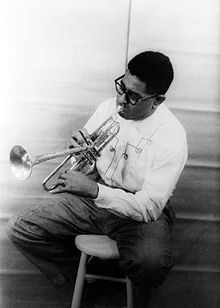
John Birks "Dizzy" Gillespie (October 21, 1917 – January 6, 1993) was an American jazz trumpeter, bandleader, singer, and composer. He was born in Cheraw, South Carolina, the youngest of nine children. Dizzy's father, James, was a local bandleader, so instruments were made available to Dizzy. He started to play the piano at the age of 4. Together with Charlie Parker, he was a major figure in the development of bebop and modern jazz. In addition to featuring in these epochal moments in bebop, he was instrumental in founding Afro-Cuban jazz, the modern jazz version of what early-jazz pioneer Jelly Roll Morton referred to as the "Spanish Tinge". Gillespie was a trumpet virtuoso and gifted improviser, building on the virtuoso style of Roy Eldridge but adding layers of harmonic complexity previously unknown in jazz. In addition to his instrumental skills, Dizzy's beret and horn-rimmed spectacles, his scat singing, his bent horn, pouched cheeks and his light-hearted personality were essential in popularizing bebop. He had an enormous impact on subsequent trumpeters, both by the example of his playing and as a mentor to younger musicians. "A Night in.
Random article
The essentials of piano sheet music Most people have the notion that sheet music is a very complicated notation and reading it very difficult. However, this is not true as understanding sheet music piano is just a matter of transcribing the various musical notes written. Uses of sheet music Piano sheet music is nothing but piano notes written in standard notations. You can avail such free sheet music online from various websites. The main use of sheet music piano is to help aspiring musicians recreate the same sequence of notes as performed by the composer of the piece. It is a method where a specific musical composition is recorded in written form using music notes. The ultimate aim of reading sheet music is to recreate the same score in as accurate a manner as is possible.  (More...)